Magic Alice ART. Salvation through art
How do you manage to paint during the war?
It’s not easy, but very effective. The first year was frankly frightening. Rockets, shelling — everything trembles… Yet the belief that everything will be fine has always been present both in me and in each of my paintings.
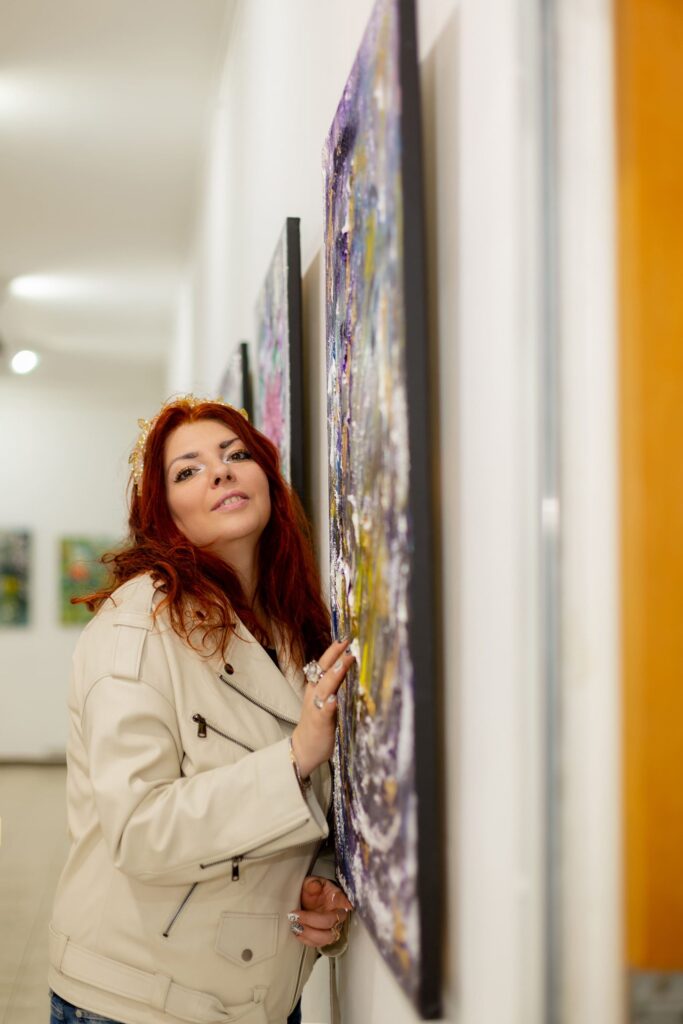
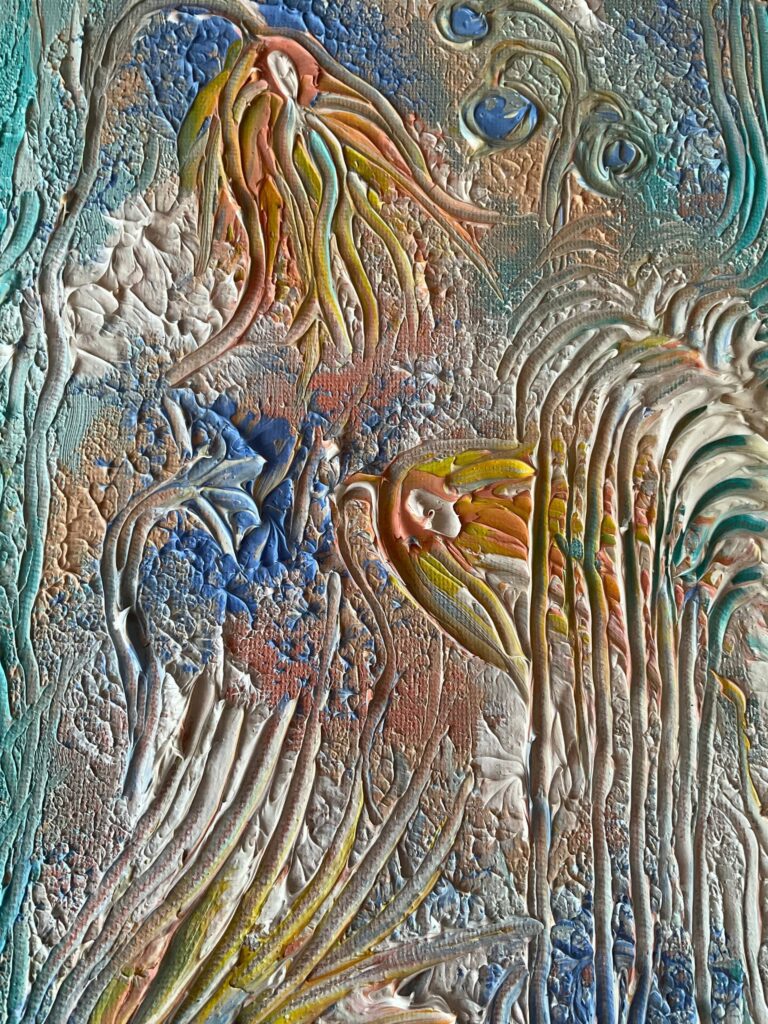
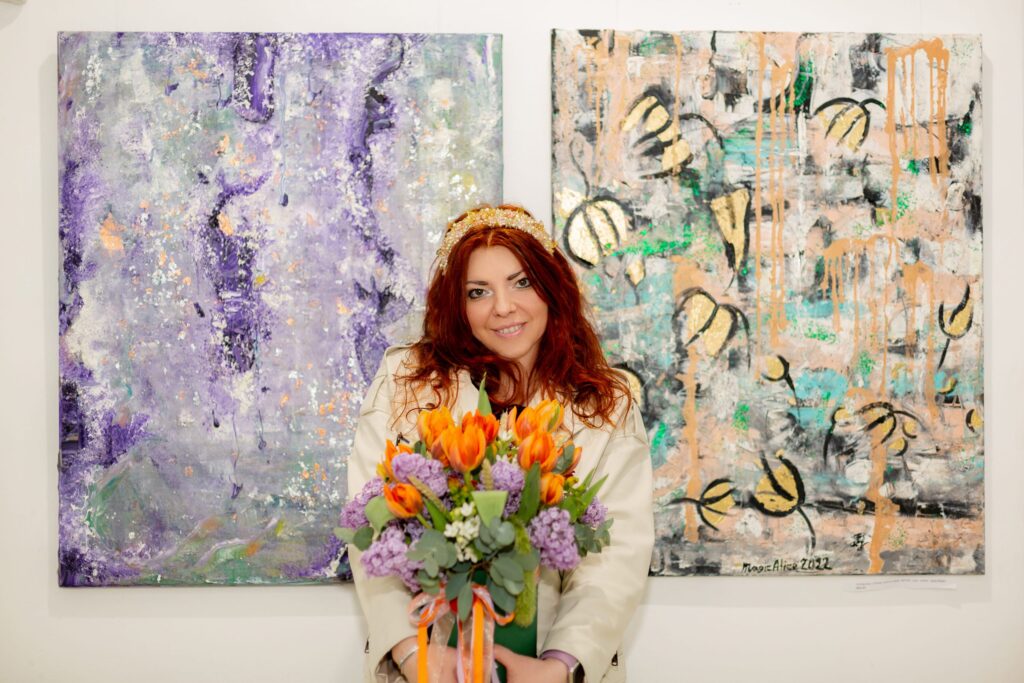
I now have more than 300 paintings created during the war. And I always try to organize an exhibition at the first opportunity, because above all it is art therapy for people, while for me the psychological aspect of the art direction is the main priority. As for me personally as an artist, I always paint while being inside the world of the painting itself; it is a kind of story you write (one that you cannot be distracted from, so as to embed precisely the meaning that is needed). A painting, like a book, tells many fascinating things, communicating directly with your thoughts through imagery. That is why paintings are “written,” not “drawn.”
How do you choose the key colors for a future painting?
I always focus on the main goal and my primary profession — psychology. Often, the concept of a painting arises directly from the needs of people attending the exhibition. The combination of colors is necessary for a person like medicine. The notion of art therapy now, during the war, is extremely helpful for everyone. In essence, we do not see holidays, joy, or bright events. We try, but the overall situation presses down. On my canvas, a person sees certain colors, and imagination begins to work, making them happier (art-neuro-lifting, I have spoken many times before about this system and how it works). Everyone sees their own. However, through colors I embed tendencies of growth, support, and positivity. Each person perceives according to their own state — mood, situation, development. In the combination of colors and shades, diagnostic and therapeutic tendencies are embedded. The detail that captures the viewer’s attention becomes the key accent of their state. These are markers that help me instantly understand a person and assist them.
So, as you can see, the selection of future compositions and colors has its own history and philosophy. I choose the key colors right away, moving toward the goal slowly but without straying from the main path. I often connect seasons with emotions of joy and happiness; all my works are unequivocally positive and will never convey negativity. There are a few philosophical works specifically in terms of color, but they always carry positivity and the energy of renewal for the viewer.
How much time does it take to complete one work?
It varies greatly. It can be a day or two. Or it can take half a year. It all depends on inspiration. It also depends on psychological projects, which can be demanding.
How do you respond to criticism?
Adequately. I am always interested in how a person perceives, what exactly, and why. But don’t forget that I am a psychologist-profiler, an expert in behavioral analysis first and foremost. Therefore, as a hobby-artist, I truly enjoy positive feedback, while as a psychologist-profiler, I find negative reactions intriguing. So everything is in balance
What would you like visitors to see in your works?
Happiness! Beauty! Lots of beauty!
What is art-neuro-lifting?
It is my own specially developed set of programs for recovery through digital art. There is a program for working with fears and phobias, one for strengthening the immune system and rejuvenation (accelerated wound healing), and another for stress management. These programs are fascinating and serve as art therapy. When we conducted group testing, we achieved results: 78% immediately, and 100% after two months and a week. This shows that the programs are effective, though some clients need a little more time. Everyone was satisfied. By the way, the programmer developed the product under shelling in Kharkiv.
How do the programs work? You simply watch the digital product containing fragments of paintings, and it relaxes you and is very pleasant. It lasts for 3 minutes. A kind of relaxation embraces your emotions, similar to visiting an art exhibition. You reflect on your own thoughts. And through consciousness, your subconscious begins to heal you. That’s the short version. Try positive digital art.
Do you collaborate with other artists?
I take part in group exhibitions. I am very grateful to the “Globus” gallery for an incredible international exhibition in the Czech Republic featuring my works. We created a wonderful duet at the KPI cultural center with Volodymyr Filatov, a world-renowned architect. He is a wonderful person and a talented master of his craft! There have been many group exhibitions at the Maria Zankovetska Museum! I am always happy to collaborate with artists!
In addition, I gratefully accept invitations to solo exhibitions — we have an incredible number of talented creators!
Do you have a favorite painting?
I love each one. They are chapters of incredible stories and wonderful moments filled with the magic of positivity! For me, they are works that inspire and bring beauty!
Do you conduct art therapy specifically as psychological sessions?
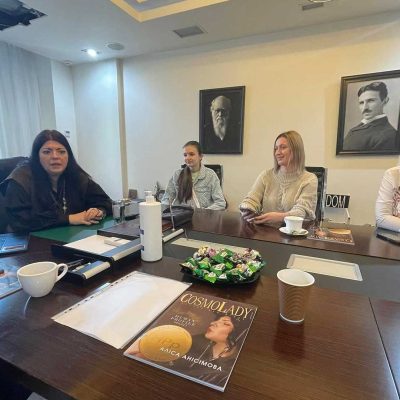
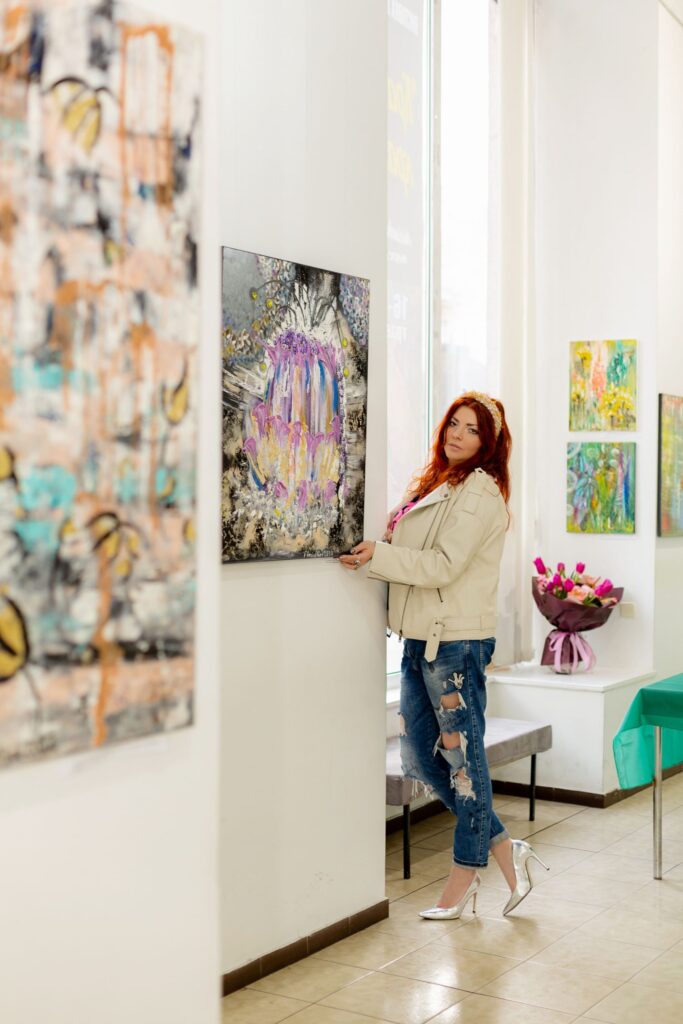
We held art therapy workshops at the “Artist” gallery, where enthusiasts gathered, recreated their dreams, and worked with hidden possibilities. Later, at the editorial office of CosmoLady magazine, we organized a permanent exhibition, and additionally launched art-neuro-lifting, art consultations, and correction using the profiling method.
What do you like in the paintings of other artists? What captures you?
Depth, philosophy, sometimes detail, style, the combination of colors. That which gives a true emotion. I am a romantic, after all! And talented works are visible immediately. For example, at the beginning of autumn I was at Andriyivskyy Descent, there were many works exhibited, but one caught me, and I still remember it. Its place is somewhere in the finest museums of Ukraine, Paris, or London! The world must see it. It is incredible, simple and complex at the same time. You seem to enter it and travel within.
A complex profession that requires high competence and keen observation — so are paintings a continuation? A form of relaxation? A parallel profiling world?
Profiling is, above all, detection. Identifying what already exists in a person, markers of what is hidden, traits and inclinations, intentions, aggression, temperament, character, and qualities — and perhaps even the risks of interacting with such a person. It defines correlations and advantages, compensations, and provides a detailed behavioral analysis. Everything happens. Situations vary. Complexity varies as well.
Art, on the contrary, is the creation of a universe with your own hands. As if you can create anything at all! It is unparalleled! Therefore, these are two worlds, because everything is relative!
Within me, a complex profession and art are united.
There are many famous artists, their names are known worldwide. And which world-famous profiler can you name?
A world-famous profiler is Santa Claus, because he knows the faces of all people in the world, every child and every adult! Their personal qualities — and he remembers it all!
Do you read a lot?
I love reading. However, I don’t always have enough time. At the moment, I have about 15 unread books waiting.
What kind of books do you enjoy?
Smart detective stories with elements of intriguing mysteries related to mystical artifacts, historical excursions, criminology, and physics. Such combinations. They compensate for my expectations from a book.
Do you have many friends?
No, only a few.
Who is the most interesting interlocutor for you?
Someone who truly loves their work and is a professional (I don’t like “time thieves”), reads a lot, and if they don’t have time for reading, continues developing in other ways (perhaps through trainings or short courses), respects others, doesn’t seek conflict, doesn’t spread negativity or offend anyone, doesn’t cross personal boundaries (no self-assertion, unsolicited advice, judgments, strange or personal questions), and has a sense of humor and intellectual flexibility. That is quite enough. At least for 15 minutes of engaging conversation.
If a person doesn’t like art, what can you say about them?
At the very least, that they love something else. Art is a matter of taste. There are different kinds of art, and different kinds of people. To each their own. Absolutely no criticism.
What matters more in art — the process or the result?
As in profiling — both. The quality of the result depends on the process
What would you like to wish our readers?
First, that everything goes well. Second, pursue what you love and know it thoroughly! And third, find yourself in something beautiful and maintain the level that fully relaxes you, stimulates you, and supports you!
Artistic dossier of Magic Alice:
• More than 300 works created during the war;
• Exclusive artist of the Coronado Gallery (USA);
• The first solo exhibition took place at the state gallery “Artist” in May 2023;
• 10 solo exhibitions, including a unique exhibition at KPI, which was documented in a film released on November 14, 2024;
• Magic Alice’s paintings were also featured in the art film Ukraine — Temple of My Heart by renowned Ukrainian directors Yulia Sak and Olha Tychyna-Yanovska, filmed in wartime Kyiv under shelling and presented to the world in 2024;
• A painting that changed its color scheme from warm to cold on the night the war began was gifted during a solo exhibition and is now displayed at the Pavlo Tychyna Museum in Kyiv;
• Held an extraordinary two-hall exhibition at the Kyiv-Pechersk Lavra, in the Museum of Theater, Music, and Cinema Arts of Ukraine;
• Recipient of an order and medal for service to art;
• Paints in the styles of Art Deco, Modern, and Designer Art;
• Website: Magic-Alice.art.
Art&Fashion
Special issue #11 2025